Selfish or selfless
My Vampire Love (Completed)“Selfish or selfless” is a recurring moral expression that concentrates Jenifer’s struggle between preserving herself and sacrificing herself for the people she loves. It first appears as a question about whether devotion can justify danger, but it gradually becomes a principle through which Jenifer defines her identity: she refuses to treat love as passive feeling and instead claims the right to act, even when the action threatens her life.
The Ethical Dilemma
The expression is rooted in a conflict between self-preservation and responsibility for another person. Jenifer has already reached a point at which physical illness, emotional exhaustion, and refusal of treatment make death seem like an escape. Her body is beginning to shut down because she has stopped taking the small brown pills, and she considers whether dying would end the pain, guilt, and heartache. In that condition, the demand to protect herself cannot be separated from the question of whether she still believes her own life is worth preserving.
Her refusal of the medication gives the dilemma a concrete form. Alone in the bathroom, she removes three pills, watches them dissolve into a faint pinkish-red stain, flushes them away, and lies to Eric Wilson afterward by claiming that she is fine. The act is private and deliberate rather than accidental. It shows that her conflict is not simply between courage and fear: she is also asserting control over a body and a future that other people repeatedly attempt to manage.
Love, Sacrifice, and Coercion
The expression becomes most direct when Eric Wilson objects to Jenifer saving him with her blood. He tells her that, if his life and hers are placed against each other, she should allow him to die rather than sacrifice herself. For Eric, protecting Jenifer means refusing to let her choose him at the cost of her own survival. His position is selfless in intention, but it also places a severe restriction on her agency by deciding in advance what she must do with her body.
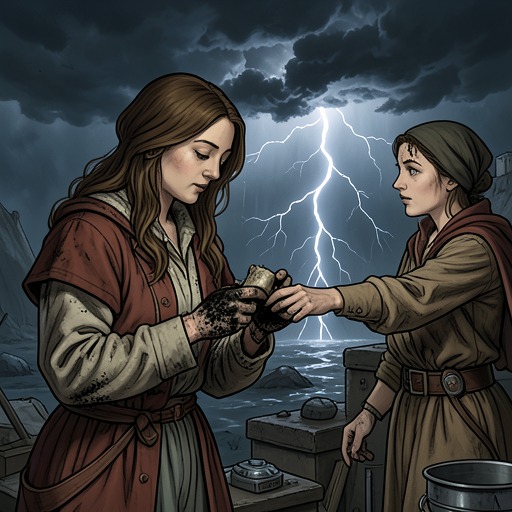
Jenifer rejects that command. She argues that she was not supposed to stand by like a “zombie” while Eric Wilson died, and declares that she will do everything in her power to keep him safe. Her language deliberately turns the moral opposition back on itself: if the choice is between being selfish and being selfless, she insists that she will be selfless where Eric is concerned. The declaration is not quiet submission. It is an act of will, made in anger, through which she refuses Eric’s attempt to define self-preservation as the only morally acceptable choice.
The scene therefore keeps both sides of the expression alive. Eric Wilson’s refusal to benefit from Jenifer’s sacrifice recognizes the value of her life, while Jenifer’s refusal to abandon him recognizes that survival without responsibility can feel like another form of death. Neither position is presented as simple. Sacrifice may express love, but it may also erase the person who sacrifices; self-protection may preserve life, but it may also become an excuse to abandon someone in immediate danger.
Freedom Against the Arranged Future
The same opposition shapes Jenifer’s resistance to marriage. She tells Eric Wilson that she would rather be miserable for her entire life and remain free than be happy inside a marriage she never wanted. Her statement makes freedom more important than promised happiness when that happiness depends on confinement. The phrase “Selfish or selfless” therefore extends beyond physical rescue into the structure of her future: choosing herself can be condemned as selfish, yet surrendering her choice can also mean surrendering the self whose happiness the marriage supposedly guarantees.
This conflict is intensified by the revelation that Jenifer must marry Eric Wilson before turning eighteen because she is expected to awaken as a vampire. Her illness makes it possible for her to become a true pure-blood vampire, while the marriage and her awakening are tied to the continued supremacy of the vampire order. Her body is treated as both endangered and strategically valuable. The language of selflessness consequently operates under institutional pressure: her personal choice is entangled with bloodline power, reproduction, and the survival of a supernatural hierarchy.
The Expression in Grief and Violence
Jenifer’s moral vocabulary is also tested by grief. Eric Wilson tells her that, if he had to choose for her, he would choose Daren. He has seen how alive and genuinely happy she appeared when she believed Daren was still alive, and he says that he would fight for her while still accepting that Daren might give her a happiness he cannot. Eric Wilson imagines selflessness as relinquishing the person he loves rather than claiming her for himself. His willingness to remain in the shadows, even painfully, turns the expression into a test of whether love can value another person’s happiness above possession.
Jenifer does not experience this ideal as uncomplicated comfort. Eric Wilson’s willingness to let her go sounds like a farewell, and her response is to hold his hand and admit that she needs him. The scene reveals a movement in her understanding: she is no longer able to preserve a rigid separation between loyalty to Daren and love for Eric Wilson. Her realization that she is in love with Eric Wilson does not erase Daren or the guilt attached to moving on; instead, it forces her to acknowledge that devotion to the dead and attachment to the living can coexist.
The phrase acquires an uglier force during the violence surrounding Brandon. Jenifer is forced to watch Zoryiaa remove Brandon’s hand and chop off his little finger at Zane’s command. Later, she attacks Zane, blaming him for placing her friends in danger, making her choose between them, and making her watch Brandon die. Her fury is not abstract moral debate. It is the accumulated pain of a witness who has been compelled to remain present while another person is tortured. When she calls herself selfless in relation to Eric Wilson, the claim carries this wider history of protection, helplessness, and rage.
Transformation and Reinterpretation
By the time Jenifer recognizes that she loves Eric Wilson, “Selfish or selfless” has shifted from a question imposed by others into a contradiction she must inhabit. She has refused medication, contemplated death, resisted an unwanted marriage, endangered herself to save Eric Wilson, remained bound by grief for Daren, and retaliated against those who harmed her friends. These actions cannot be reduced to either pure selfishness or pure selflessness. They show a person trying to recover authorship of her choices while still accepting that every choice affects those she loves.
The eventual wedding gives the expression its most significant reinterpretation. Jenifer and Eric Wilson become husband and wife, cut a ten-tier white cake decorated with cream and white flowers, and share a first dance to “All My Life” by K-ci and Jojo. The marriage that once represented a golden cage is no longer experienced solely as an externally imposed destiny; Jenifer understands it through the love she has chosen to acknowledge. Yet the earlier conflict remains important because the later happiness has meaning only after her resistance. The story does not make selflessness valuable by erasing her demand for freedom. Instead, it frames love as most meaningful when sacrifice and choice are held together rather than confused with one another.